
Transportation of petroleum products through pipeline presents Flow Assurance considerable risks including wax formation and deposition as a result of heat loss of fluids, which is harmful to the flow due to the reduced inner diameter or totally blocked pipelines in extreme cases. The production Flow Assurance interruption due to blocked pipelines can cause colossal financial loss. Therefore, in order to diminish those adverse effects, it is critical that pipeline design for flow assurance should be considered. Flow assurance is a relatively new field in oil and gas industry, it means that the flow of hydrocarbon stream from one point to another must be ensured successfully and economically. Although flow assurance is extremely diverse, encompassing many discrete and specialized subjects and bridging across the full gamut of engineering disciplines, our work concentrated principally on the study of wax deposit in the pipelines. The main purpose of this paper is to focus on the aspect of material in pipeline design and the selection of thermal insulation coatings. Furthermore, operating parameters such as pressure, temperature and flowrate will be examined to achieve optimum results. For the case study in this paper, the pipeline connecting Ca NguVang Oilfield’s Wellhead Platform (WHP) to the Central Processing Platform of Bach Ho Oilfield (CPP-3) in Vietnam will be studied. Hence, this work covers several aspects, namely the theoretical study, the modeling using Excel as well as using specialized software OLGA, and finally the application for a real case in the petroleum industry in Vietnam.
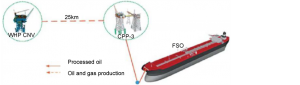
Oil and gas fields in Vietnam are located hundreds of kilometers offshore in which producing and processing procedures are separated and conducted on different platforms. These platforms are connected by a pipeline system lying on the seabed. Specifically, crude oil is transferred from the Wellhead Platform of Ca NguVang field to the Central Processing Platform of Bach Ho field, where crude oil is under processing, by the approximately-25-kilometer-length pipeline (Figure 1).
Ca NguVang field is operated by Hoan Vu Joint Operating Company. As a result of an average reserve, which ranges between 6200 – 20,000 barrels/day [1] , it is impossible to develop this field independently because of economic issues. In order to minimize the development cost, it is suggested that Ca NguVang field should be connected with Bach Ho field by the subsea pipeline system. The produced oil from Ca NguVang field has a high concentration of paraffin, which tends to cause wax deposition in pipes.
Crude oil is a mixture of waxes, aromatics, naphthenes, asphaltenes, and resins. At typical reservoir temperatures and pressure, wax molecules are dissolved in the crude oil. As the produced oil flows through a subsea pipeline lying on the ocean floor, its temperature drops below WAT (Wax Appearance Temperature) because of heat loss along the pipeline [2] . Waxes in the oil form deposits on the inner pipe wall then become thicker with time, which leads to serious problems related to flow assurance [3] . In the worst-case scenario, the whole process of transport must be stopped for the replacement of the plugged section of the pipe. The estimated cost could be up to approximately $30,000,000 per incident [4] .
In fact, there were a number of accidents related to flow assurance which was attributed to wax deposition. From 1992 to 2002, over 50 cases of pipeline blocking due to wax deposition were reported in Gulf of Mexico [5] . In which, the replacing cost was $5,000,000, with a downtime of 40 days constituted approximately $25,000,000 [6] . One of the most severe cases happened at Staffa field in North Sea, UK [7] . The offshore platform was terribly damaged by wax deposition; to the point that it was left abandoned at the total cost of $100,000,000 [6] .
In respond to the consequences of wax deposition, many studies of flow assurance are now focusing on remedy and prevention techniques.