
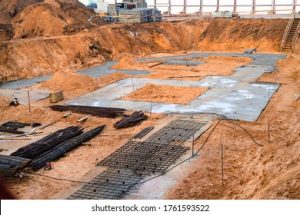
Foundation pit excavation engineering is an old subject full of decision Deep Foundation making. Yet, it still deserves further research due to the associated Deep Foundation high failure cost and the complexity of the geological conditions and/or the surrounding existing infrastructure around it. This article overviews the risk control practice of foundation pit excavation projects in close proximity to existing disconnected piled raft. More focus is given to geotechnical aspects. The review begins with achievements to ensure excavation performance requirements, and follows to discuss the complex soil structure interaction involved among the fundamental components: the retaining wall, mat, piles, cushion, and the soil. After bringing consensus points to practicing engineers and decision makers, it then suggests possible future research directions.
Burgeoning intentions to use basement slabs as a component contributing to the foundation’s bearing capacity and settlement requirements have recently spurred an escalated demand for piled-rafts as an economical alternative foundation system. The 828 m tall Burji Khalifa building in Dubai is an example founded on piles beneath the base of thick slab—the raft [1]. Moreover, raft foundations integrated with column type ground improvement (rigid inclusions) have widely been practiced in many parts of the world to utilize marginal urban soft ground [2]. In China, the columns are mainly constructed with cement-fly-ash-gravel (CFG) and the improved ground is termed as CFG pile composite foundation [3] [4] [5]. The 200 m high structure in Dalian City, China, for example, was built on composite foundation where the raft transfers the load from the superstructure to the ground treated by vertical columns [6]. This shows, based on the intended use, piles may be connected or disconnected to the raft. To circumvent localized higher stress and bending moment at the point of connection between the piles’ head and the raft during lateral and seismic loads, an interposed layer of sufficient thickness is laid [7] [8]. Previous experimental and numerical analyses indicated that the disconnecting layer plays a significant role in distributing superstructure loads in such an interplay that integrates the piles and the soil in load sharing mechanism [9] [10]. In this case, the piles receive the upper load indirectly and mostly considered as stiffeners of the marginal ground or settlement reducers [11]. Many researches are now being done to understand the complex soil-structure interaction (SSI) phenomena in disconnected piled rafts [12] [13] [14] [15].
On the other hand, in recent years, the use of underground space has evidently become an important attribute to promote sustainable development [16] [17] [18]. In fact, aggressive progress towards underground construction will spate in a complex manner, with stringent performance requirement for deep foundation pit excavation support [19] [20] [21] [22]. The consequences of foundation pit excavation support’s failures are significantly dangerous and risky, mandating proper monitoring during construction [23] [24] [25]. For example, the 2004’s sudden collapse of Singapore’s deep braced excavation of Mass Rapid Transit Circle Line project adjacent to Nicoll Highway was reported to result in a disaster in four fatalities, costing approximately $6.7 billion [26]. The Chinese Hangzhou Metro Line 1 project collapse in 2008 was found to take 17 lives and other four missing, with more than ¥50 million loss [27]. Such catastrophic collapses affect the performance of the surrounding infrastructures; similar to the toppling of the 13-floor building in Minhang District of Shanghai, China causing huge social effects [28]. In 2009, the failure of deep excavation at the Cologne metro station in Germany was anticipated to be due to the increase in hydraulic gradient during the excavation, in turn the historical City Archive Building collapsed [29].
When neighboring structures or public utilities exist, the design and performance requirement of deep excavation project is met on the bases of serviceability rather than failure prevention criteria [20] [30]. The construction method must also be able to confirm practically that the induced ground movement is tolerable, so the subsequent associated risks are controlled. Previous research on the design and construction on deep foundation pit excavation works mainly focused on excavation pit support, related ground and wall movements, design and/or construction risks (see Table 1).
Regardless of whether the project is delivered by traditional Design-Bid-Build or Design-build bidding, the construction of deep foundation pit excavation is
still fraught with challenges. It requires progressive monitoring of project performance. If deviations from design expectations are encountered during construction, appropriate modifications will be made and the experience gained can be used in a different way in the future [82]. This process usually takes five stages: Information, Analysis, Prediction, Observation and Evaluation [83]. Limited data, as well as the spatial variation of material properties involved in the complex geo-environment and unavailability of soil model to capture all aspects of material’s behavior, have forced geotechnical engineers to rely on simplification and engineering judgment to fit analysis and prediction results [5] [34] [84]. This helped to develop presumed designs and safe constructability. Moreover, in the observation process, handling critical data requires more attention than the mechanics and manipulation of the data. Then, during evaluation process, the questions arising from the deviation between observed performance and expected performance will be answered. The results of the analysis will indicate the source of associated risks (hazards) and possible control measures to minimize/alleviate these risks. Therefore, a risk control process that accommodates the daily changes during construction is necessary for the successful completion of deep excavation pit project safely.
With this in mind, it becomes self-evident that the success of deep foundation pit excavation project is reflected on how it links the competence of project management process with risk-informed decision making. Besides, in the context of reasoned geotechnical judgment that systematically combines “data” and “experience”, it can succinctly be described that a pressing demand is currently prompted on the role of relevant data which explicitly takes uncertainties into account. Consequently, it is unlikely to possibly reduce taking heed to risks in the near future, especially when novel foundations systems emerge. At this point of departure, this paper enlightens the construction profession regarding geotechnical aspects of risk control and management practice for new foundation pit excavations near the recent widely used on-service disconnected piled rafts.
In what follows, the method for predicting the likelihood and occurrence of unintended events in the deep foundation pit excavation project adjacent to conventional foundation system is introduced first. Then, for space brevity, brief discussion in the context of disconnected piled raft is covertly provided under separate sections allocated to topics on how to confront uncertainties during risk prediction; risk control measures; and risk management process. Ultimately, as there always exists something to explore in any area of study, future research directions, at least to the level of this article, are forwarded for interested scholars. Since several parties are involved to partake decisions at different levels, final decision will be affected by a certain sources of bias among the stakeholders [85]. Geotechnical engineers are responsible to make clear geotechnical bias sources for better decision makings. Accordingly, this paper gives more attention to demonstrate geotechnical aspects; and organizes the challenges arising from direct or indirect risks for deep foundation pit excavations in close proximity to existing structures supported by disconnected piled rafts. The concepts discussed will help practicing engineers to resolve the impact of uncertainties in a well-organized and structured manner.